Importing clothing can be profitable for Iraqi retailers and distributors, but the cheapest factory price does
not always produce the best final margin. Shipping costs, minimum order quantities, production time, customs
duties, product quality and the risk of unsold stock all affect the real cost of an order.
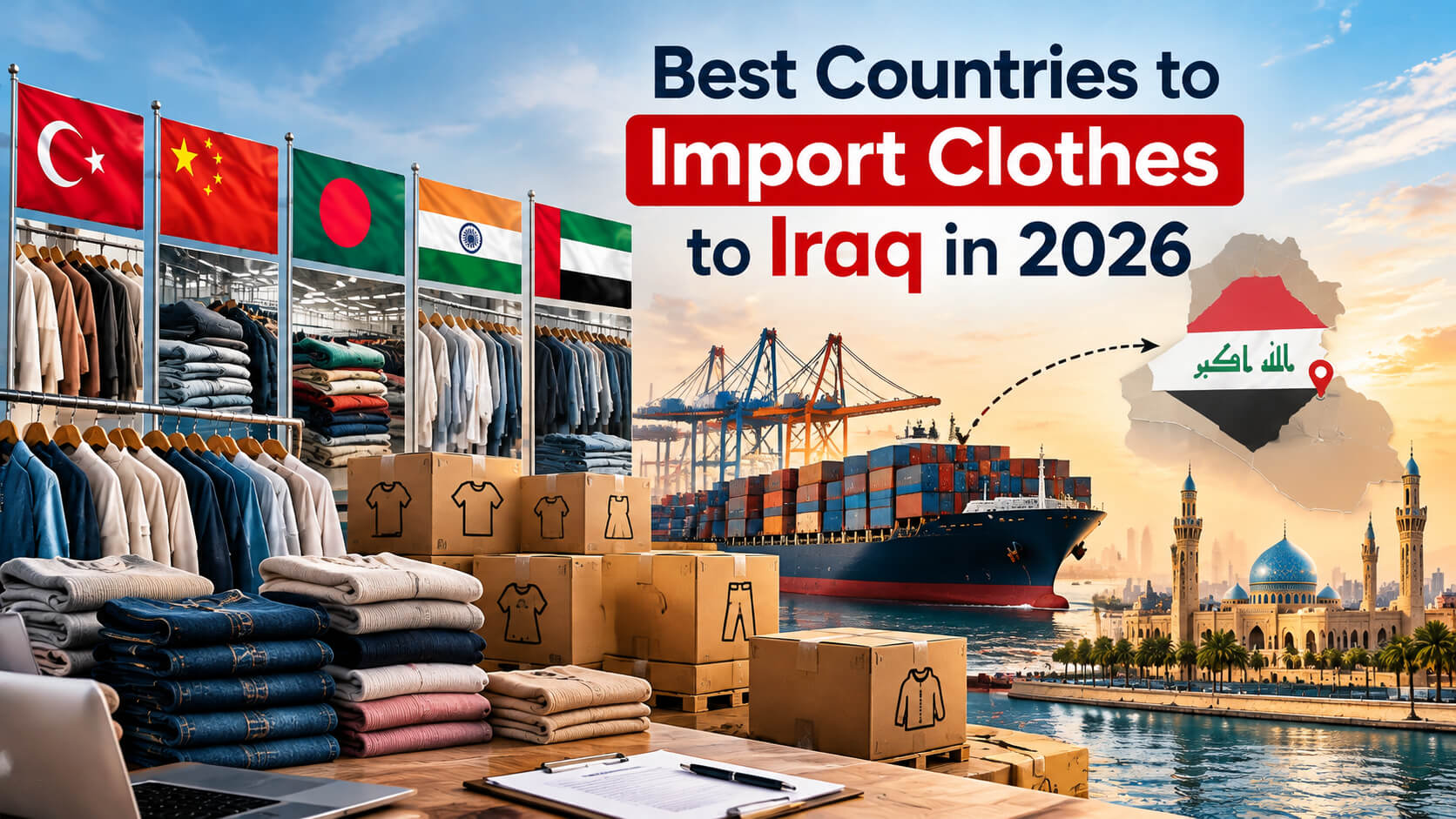
For businesses searching for the best country to import clothes to Iraq, Turkey, China
and Bangladesh deserve the closest attention. Turkey is often a practical choice for fashion-led orders and
faster regional sourcing, China offers exceptional variety and supplier choice, while Bangladesh is
particularly attractive for larger orders of basic and private-label garments.
This guide compares the main sourcing countries and explains how Iraqi buyers can choose based on their
products, budget and business model.
Turkey is often the best all-round sourcing country for Iraqi clothing retailers that prioritize fashion
variety, relatively short supply routes and manageable restocking, while China can be better for broad product
selection and competitive manufacturing. Bangladesh is especially strong for larger-volume basics and
private-label production. The right choice ultimately depends on your product, quantity, quality standard and
total landed cost.
Current trade data confirms that both Turkey and China already have substantial apparel trade relationships with
Iraq. Partner-reported UN Comtrade data shows Turkey exported about $433 million of knitted apparel under HS
Chapter 61 to Iraq in 2025. China is also a major supplier across several clothing and apparel-related
categories.
There is no single sourcing country that wins in every category.
These are sourcing characteristics rather than fixed rules.
Quotes can vary considerably between factories, seasons, materials and order sizes. For many Iraqi retailers, Turkey is one of the strongest overall
options, particularly when product style and replenishment speed matter as much as factory price. Turkey has a large textile and garment manufacturing industry
and established commercial links with Iraq. Trade data for 2025 records approximately $433.16 million in Turkish
exports of knitted apparel under HS Chapter 61 to Iraq. Businesses that import clothes from Turkey to Iraq may also
benefit from geographic proximity compared with Asian manufacturing centers. The bigger advantage, however, is flexibility. A retailer
that follows changing fashion demand may prefer ordering smaller collections more frequently rather than
committing money to a very large shipment months in advance. Turkey may be less attractive when your business depends almost entirely on
achieving the lowest possible manufacturing cost for a high-volume basic garment. A large importer purchasing tens of thousands of identical T-shirts,
polo shirts or sweatshirts should compare Turkish quotes with Bangladesh, China and India before ordering. Best suited to: Iraqi wholesalers,
boutiques, regional retailers and importers that value fashion range and replenishment flexibility. China remains one of the strongest choices for businesses needing
enormous product variety. If you want to import clothes from China to Iraq, you can
source finished garments, fashion accessories, uniforms, sportswear, children's clothing, packaging and related
products from the same market. World Bank WITS data based on UN Comtrade shows China as a
leading supplier to Iraq in several apparel-related classifications. For example, China accounted for about
$19.56 million of Iraq's $22.65 million imports in the HS 6210 garment category reported for 2024. China is particularly useful when you need: China also offers suppliers at almost every price point. That creates an important risk: two factories quoting the
same product can deliver very different fabric weight, stitching quality, sizing and finishing. Never select a Chinese supplier based only on the lowest
quotation. Ask potential suppliers for: A pre-production sample is especially important for custom clothing. Best suited to: Importers needing product
variety, customization or scalable production. Bangladesh is a major option for businesses buying basic garments
and larger private-label orders. Bangladesh garment suppliers are particularly associated with
large-scale production of knitwear and woven apparel. Common sourcing categories include: For Iraqi buyers, Bangladesh becomes more attractive as order
volume increases. Suppose an importer needs 15,000 basic cotton T-shirts in several colors. A Turkish wholesaler might provide faster availability, but a suitable
Bangladeshi factory may offer stronger economics when manufacturing a large standardized order directly. However, factory MOQ requirements can make Bangladesh less convenient
for a small shop that wants only 100 or 200 pieces across many styles. Trade data also shows direct garment flows between Bangladesh and Iraq
in specific categories, although volumes differ significantly by HS classification. Best suited to: Established wholesalers,
distributors, uniform suppliers and private-label brands purchasing at scale. India deserves consideration when cotton products, printed
garments and flexible apparel manufacturing are important. Indian suppliers produce a wide range of: India can be particularly useful when buyers want a balance
between manufacturing cost and customization. The disadvantage is that supplier capability varies greatly.
A small workshop and a large export factory may advertise similar products online while operating at completely
different quality-control levels. Ask for production details before paying a deposit. Best suited to: Businesses sourcing cotton
products, custom styles and medium-to-large private-label orders. The UAE is different from Bangladesh, China, India and Turkey
because much of its value comes from regional distribution and re-exporting, rather than low-cost garment
manufacturing. Dubai and other UAE trading centers can be useful for buyers
who want mixed merchandise from several origins without dealing directly with multiple factories. World Bank WITS data shows the UAE appearing as an important
source for Iraq in certain apparel and garment categories. For example, it supplied about $2.38 million of
Iraq's imports recorded under HS 6210 in 2024. The trade-off is price. An intermediary's margin can make the
unit cost higher than buying directly from a factory. Best suited to: Smaller importers,
mixed-stock buyers and businesses testing products before committing to factory-scale orders. The best decision becomes clearer when you start with the business
model rather than the country. Consider Turkey or UAE wholesalers. Why? You may need many designs but only a few pieces of each. A slightly higher
unit price can be safer than locking capital into thousands of units. Compare China, Bangladesh and Turkey. At this scale, factory pricing, container utilization and landed cost become
more important. Compare Turkey, China, Bangladesh and India based on the garment. A Turkish factory may work well for fashion-led collections, while Bangladesh
can make more sense for high-volume basics. Compare Bangladesh, China and India. Uniform orders usually benefit from standardized production and larger
quantities. The correct way to compare clothing import costs in Iraq is to
calculate landed cost rather than looking only at the supplier's garment price. For example, Supplier A might quote a T-shirt at $3.20 while
Supplier B quotes $3.55. Supplier A is not automatically cheaper. If Supplier A requires expensive freight, larger cartons or a
much higher MOQ, Supplier B could produce the lower final cost per sellable garment. Iraq has been implementing updated and more automated customs procedures.
Iraqi Customs said in February 2026 that tariff rates depend on the contents and classification of each shipment
and can begin at 5%. The country's ASYCUDA customs system uses the HS classification and declared or assessed
value during customs processing. Do not use a generic percentage from an online article to calculate your
final clothing duty. Verify the current HS code and applicable tariff with Iraqi Customs or a
qualified customs broker before placing the order. Iraq's tariff framework has also undergone recent updates and
harmonization, making current verification particularly important. Compare suppliers using the landed cost per sellable unit. Use this simple framework:
Landed Cost Per Unit = Total Purchasing + Freight + Import + Clearance Costs ÷ Sellable Units
Then compare: A $4 garment that sells quickly can be more profitable than a
$2.80 garment that remains unsold. This is especially important in fashion, where old stock can
erase the savings gained from low wholesale apparel prices. A structured buying process reduces supplier and quality
risks. Specify the garment type, material, sizes, colors, target quality and
quantity. Work backward from the expected Iraqi retail or wholesale price. Do not depend on a single quotation. Compare suppliers from two or more sourcing countries where practical.
Check: Check fabric, stitching, shrinkage, sizing, color and finishing. Your purchase agreement should clearly state specifications, quantity, price,
payment terms, inspection requirements and delivery terms. Do this before confirming production. For significant orders, consider independent pre-shipment inspection. Iraqi customs procedures require appropriate commercial and shipping
documentation. Requirements can depend on the shipment, origin and product classification, so confirm the
current documentation with your customs agent before dispatch. A retailer wants 500 women's fashion pieces across 40 styles. A nearby Turkish wholesaler or manufacturer may be more practical than a
large Bangladesh factory because style variety and lower quantities matter more than obtaining the lowest
manufacturing price. The company needs 20,000 basic T-shirts with custom labels. Bangladesh and China deserve serious comparison because production
volume is high enough for factory-scale sourcing. The buyer should compare FOB price, fabric GSM, MOQ, printing or
embroidery cost, production time and landed price. The seller does not yet know which styles will sell. Ordering thousands of units directly from a factory creates unnecessary
inventory risk. A smaller initial order from Turkey, the UAE or another suitable
wholesaler may cost more per item but allow the seller to test demand before scaling. A low quotation can hide lighter fabric, poor stitching, inaccurate sizing or
additional charges. A low unit price means little if the factory requires more inventory than you can
realistically sell. Photos cannot confirm fabric feel, measurements or construction quality. Freight, duty and clearance can change which supplier is actually cheaper. Customs classification affects duties and clearance. Confirm classification before
shipment rather than guessing. Negotiate reasonable payment terms and use suitable payment safeguards whenever
possible. Trends change. Slow-moving stock ties up working capital and storage space. The most effective sourcing strategy is often to use different
countries for different parts of your inventory. For example: Before comparing clothing manufacturers for Iraq, create one
specification sheet and send exactly the same requirements to every supplier. Ask every supplier to quote: This creates an apples-to-apples comparison. China and Bangladesh can offer highly competitive clothing production costs,
particularly on larger orders, but neither is automatically the cheapest after shipping and import expenses.
Compare landed cost rather than factory price. Turkey may sometimes produce a better overall result when
lower quantities, faster replenishment or regional logistics reduce inventory and transport costs. Turkey may suit Iraqi businesses that prioritize fashion, regional sourcing and
frequent restocking, while China is stronger for product variety and large-scale manufacturing options. The
better country depends on what you sell. Ask suppliers in both markets for equivalent specifications and
compare quality, MOQ, lead time and landed price. Yes, particularly for larger orders of basic and private-label garments.
Bangladesh garment suppliers have extensive capacity in T-shirts, knitwear, shirts, trousers and similar
mass-market products. It may be less suitable for a small retailer needing dozens of designs in very small
quantities because many factories work with higher minimum order quantities. Start with verified manufacturers, request company documentation and order
samples before committing to bulk production. Confirm whether the supplier is the actual manufacturer or a
trading company. For larger orders, consider factory audits or independent inspections. Never rely only on
marketplace ratings, product photos or a salesperson's claims. Commercial and shipping documentation is required, but the exact documents can
depend on origin, shipment type and current Iraqi customs rules. Common documents may include commercial
invoices, certificates of origin and bills of lading or equivalent transport documents. Confirm current
requirements with Iraqi Customs and your licensed customs broker before shipping. Add the garment price, origin-country transport, freight, insurance where
relevant, customs duty, clearance fees and final domestic delivery. Divide the complete amount by the number
of sellable garments. Verify the correct HS classification before estimating customs charges because Iraq
applies tariff treatment according to product classification. Yes, if the factory's MOQ fits the retailer's budget and inventory needs.
However, direct manufacturing is not automatically the best option for small shops. Wholesalers in Turkey,
China or regional trading hubs can sometimes offer smaller quantities and greater style variety, reducing
the risk of holding unsold stock. Bangladesh, China, Turkey and India can all support private-label clothing, but
the best option depends on the garment and quantity. Bangladesh is worth considering for volume basics,
China for broad manufacturing capabilities, Turkey for fashion-oriented collections and India for cotton and
customized products. Compare samples before selecting a production partner.
There is no universal best country to import clothes to Iraq because each sourcing market solves a different
business problem.
Turkey is a strong all-round option for fashion retailers, wholesalers and businesses that value regional
sourcing and faster replenishment. China offers one of the widest supplier and product selections. Bangladesh
becomes particularly attractive for larger standardized or private-label orders, while India and the UAE can
fill specific sourcing needs.
Before placing a bulk order, compare suppliers using the same product specifications and calculate the complete
landed cost. Verify samples, production terms, HS classification and current Iraqi customs requirements.
The country with the lowest factory price is not necessarily the
country that gives your business the best profit.
What Is the Best Country to Import
Clothes to Iraq?
Which Countries Are Best for
Sourcing Clothes for Iraq?
Country
Best For
Price Position
Typical Order Scale
Main Consideration
Turkey
Fashion, casualwear, fast restocking
Medium
Small to large
Usually easier regional logistics
China
Variety, accessories, mass-market apparel
Low to medium
Small to very large
Supplier quality varies widely
Bangladesh
Basics, knitwear, private label
Competitive at volume
Medium to very large
Larger MOQs are common
India
Cotton clothing, fashion, ethnic styles
Low to medium
Small to large
Supplier verification matters
UAE
Consolidation and regional wholesale buying
Medium to high
Small to medium
Often a trading hub rather than factory source
1. Is Turkey the Best Country to
Import Clothes to Iraq?
Turkey can be suitable for:
When Turkey may not be the best choice
2. Should You Import Clothes from
China to Iraq?
Why importers choose China
What should Iraqi buyers verify?
3. Is Bangladesh Good for
Wholesale Clothing Imports?
Where Bangladesh has an advantage
4. When Is India a Good Clothing
Sourcing Option?
5. Is the UAE a Good Place to
Source Clothing for Iraq?
UAE sourcing makes sense when:
Which Country Is Best for
Different Clothing Businesses?
Small clothing shop
Large wholesale distributor
Private-label fashion brand
Uniform supplier
How Much Does It Cost to Import
Clothes to Iraq?
Landed cost includes:
Important customs note for 2026
How Do You Compare Wholesale
Apparel Prices Correctly?
What Is the Best Process for
International Clothing Sourcing?
Step 1: Define your product
Step 2: Create a target landed cost
Step 3: Shortlist several suppliers
Step 4: Verify the supplier
Step 5: Order samples
Step 6: Confirm commercial terms
Step 7: Calculate shipping and Iraqi customs costs
Step 8: Inspect before shipment
Step 9: Keep all import documents organized
Practical Clothing Sourcing
Examples
Example 1: Baghdad fashion retailer
Example 2: Iraqi wholesale T-shirt distributor
Example 3: New online clothing seller
Common Mistakes Iraqi Clothing
Importers Should Avoid
Choosing the lowest-priced supplier
Ignoring MOQ
Skipping samples
Comparing FOB prices instead of landed cost
Using the wrong HS code
Paying too much upfront
Ordering too much fashion inventory
Expert Tips for Choosing Wholesale
Clothing Suppliers for Iraq
Frequently Asked Questions
What is the cheapest country to import clothes from to Iraq?
Is Turkey or China better for importing clothes to Iraq?
Is Bangladesh a good country for importing clothes to Iraq?
How can I find reliable clothing manufacturers for Iraq?
What documents are needed for shipping clothes to Iraq?
How do I calculate clothing import costs in Iraq?
Can a small retailer import clothes directly from a factory?
Which country is best for private-label clothes for the Iraqi
market?
Conclusion
Need help finding the right supplier country? Contact Spider Textile today.
Get a Quote